
Microcement: a seamless finish for floors, walls and bathrooms
Microcement (microsement in Icelandic) is a thin concrete-look coating applied by hand at 2–3 mm and sealed. No grout, no joints, and usually laid straight over what is already there. Here is what we are asked most: what it is, where it suits, how it is laid, what it costs and how it lasts.
Or call 844 8515
What is microcement?
Microcement is a decorative coating of cement, polymers, fibres and very fine aggregates. It is trowelled on in thin layers, sanded between coats and sealed at the end. The result is one continuous surface, 2–3 mm thick, with a living texture that recalls concrete but feels warmer and softer.
Because the layer is so thin, there is no need to break out old tiles or raise floors. We prime what is there, reinforce it with mesh and lay straight on top. That saves time, money and mess, and it is why microcement has become the first choice for many when a bathroom or floor gets a new life.
Where does microcement suit?
Floors
Living rooms, hallways, kitchens, shops and restaurants. One continuous floor through the whole home, laid over tiles, concrete or screed. Works well with underfloor heating.
Microcement floorsBathrooms and showers
Walls, floor and shower as one surface, waterproof in every layer. Our most common job.
Microcement bathroomsWalls
A living, clouded stone texture on one wall or the whole room. A full-height wall costs less per square metre than a partial one, because edges and taping set the time.
Worktops and joinery
Kitchen islands, vanities and shop counters clad in one piece, with the sink set straight into the surface.
Stairs
Treads and stairwells without joints, with a coarser texture where more grip is needed.
Commercial spaces
Shops, restaurants and offices. Stands up to the traffic, is easy to clean and looks the same after many years.
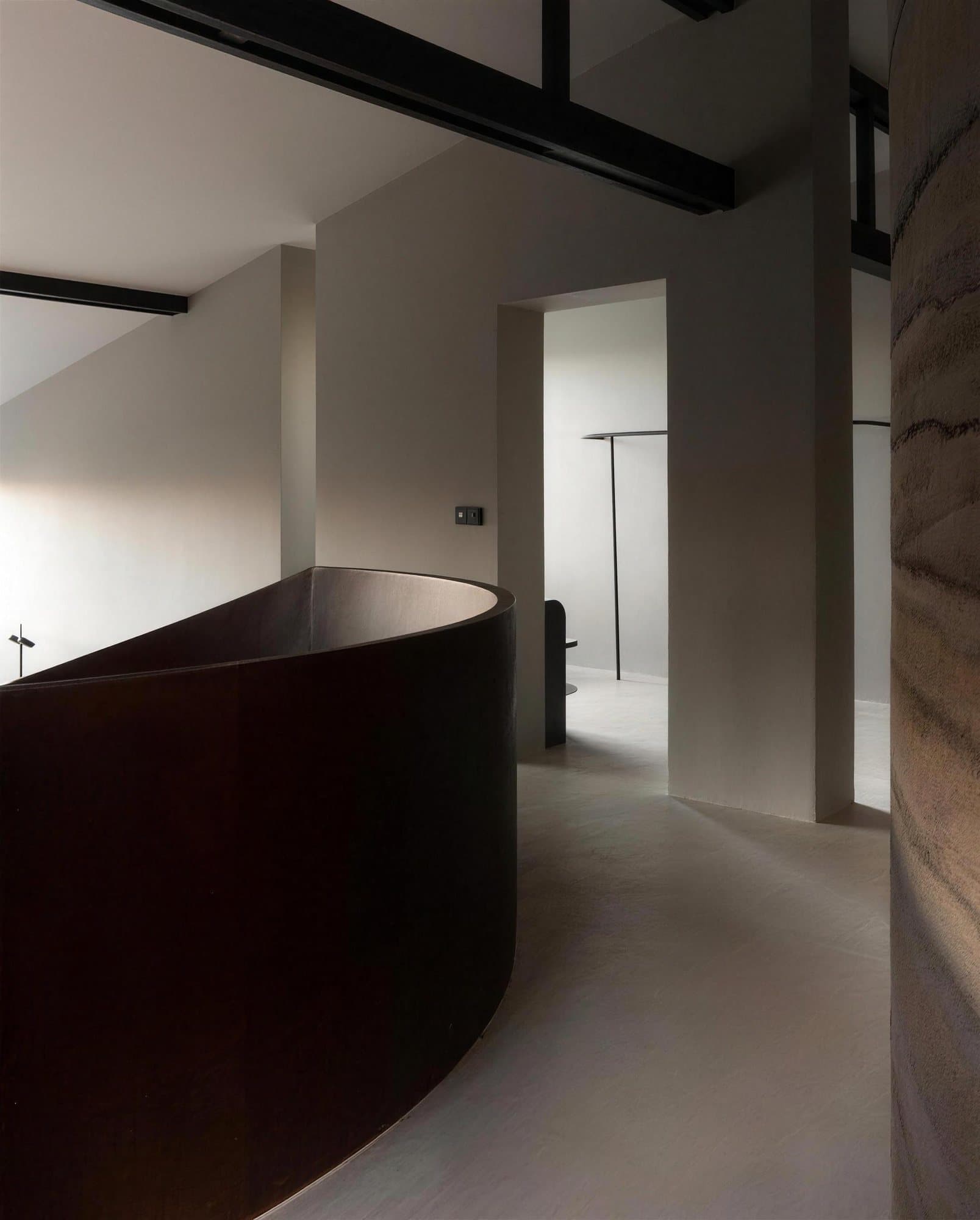
Floor, house in Reykjavík
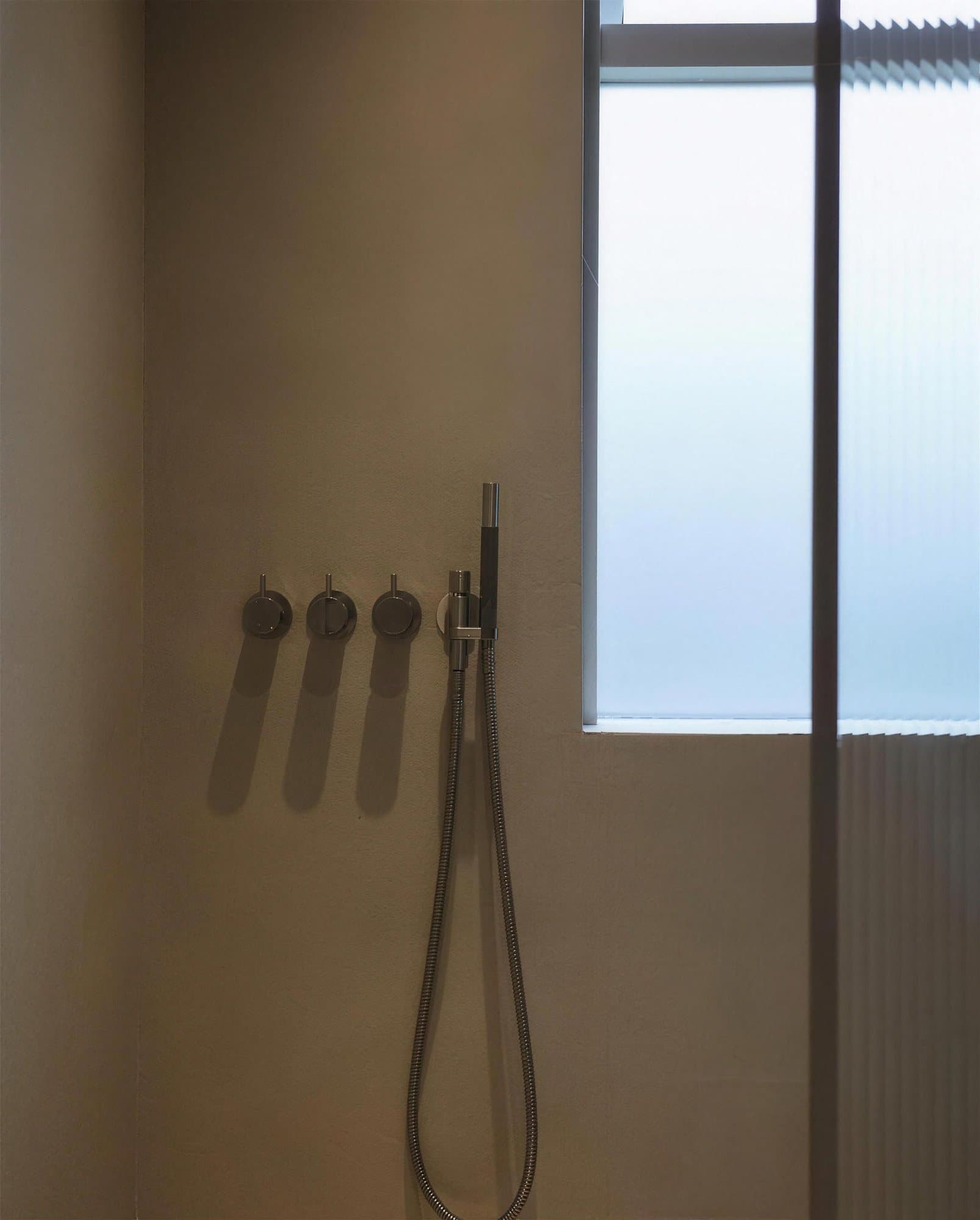
Shower, waterproof in every layer
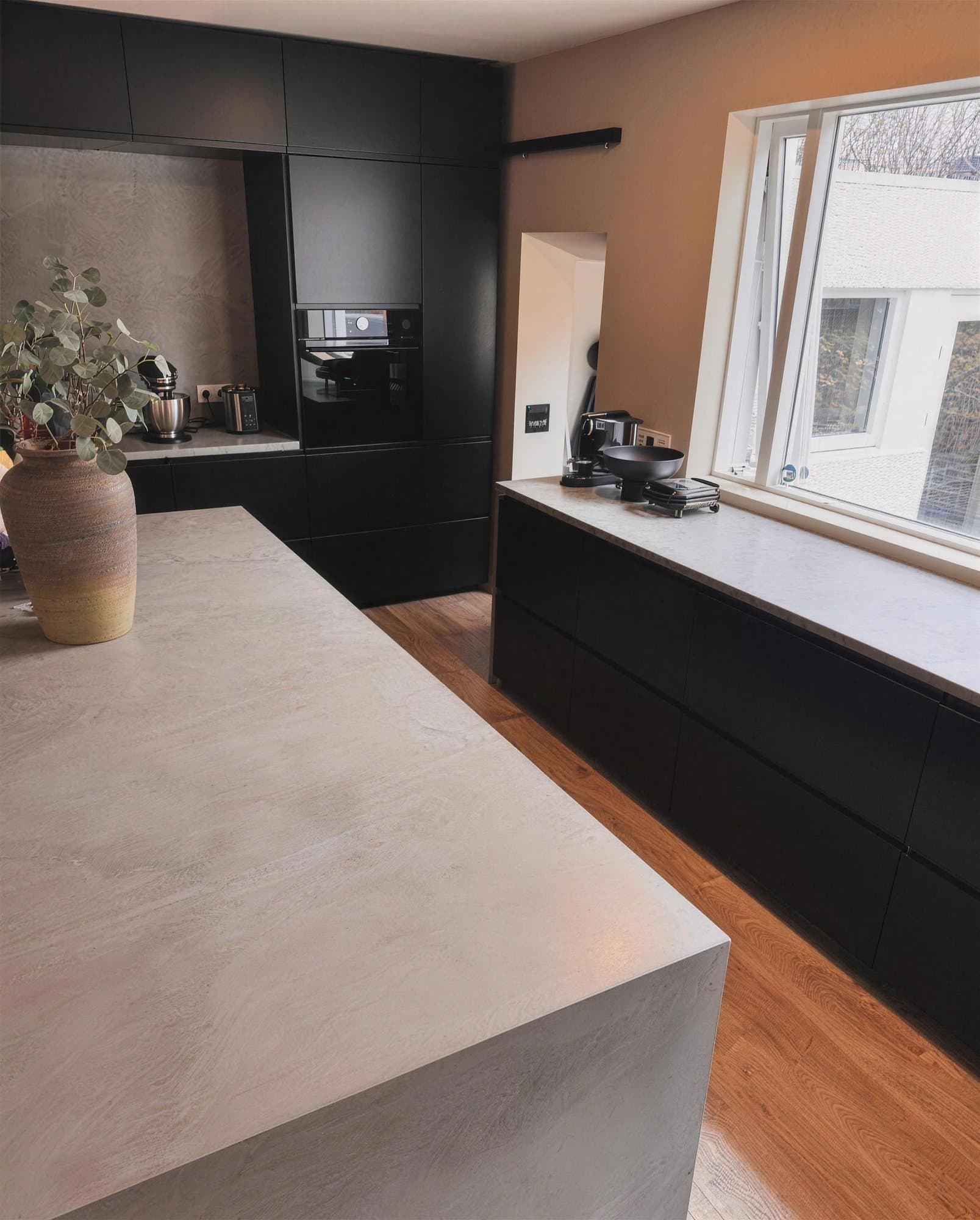
Kitchen island, Garðabær
Two kinds, one system
We work with two kinds of microcement. A ready-mixed paste that is waterproof in every single layer, not just in the lacquer, which we use in wet rooms and on worktops because it does not darken if water reaches it. And a powder mixed with water, with very high compressive strength and fire class A1, which suits large floors and walls in dry rooms best.
The build-up is the same in both: primer and mesh, two base coats, two finish coats, pore filler and lacquer. Seven layers that together make three millimetres. Click the layers below to see what each one does.
Seven layers. Three millimetres.
Microcement is not a paint but a system. Each layer goes on once the one beneath has dried and been sanded, and together they form a 2–3 mm surface without seams. Click the layers to see what each one does.
The layers, top down
We work with two kinds of microcement: a ready-mixed paste that is waterproof throughout and suits wet rooms and worktops, and a powder mixed with water that suits large floors. The layer build-up is the same.
5 / 7
Finish coat 2
- Material
- Same material, same colour
- Thickness
- 0.5 mm
- Drying
- 12–24 h
The layer you see and touch. Sanded fine, vacuumed and wiped with a damp cloth before the lacquer goes on.
After the last coat of lacquer
Cleaning after that: a damp cloth and a pH-neutral soap. Never chlorine, acidic cleaners or scouring sponges.
24 h
Walk carefully in socks
48 h
Light furniture with felt pads, no water
7 days
Water and a damp cloth, the shower in use
30 days
Fully cured: heavy furniture, rugs and carpets
What does microcement cost?
The price depends on the square metres, the substrate and how many surfaces are done. A floor alone costs less per square metre than floor, walls and shower together, and small jobs cost more per square metre than large ones, because buckets, edges and drying time weigh the same whether the room is four square metres or forty.
| Full-height walls | 32,000–38,000 ISK per m² |
|---|---|
| Bathrooms, walls and floor | 38,000–48,000 ISK per m² |
| Floors | Depends on the size of the floor, quoted the same day |
| Worktops and bespoke pieces | From about 56,000 ISK per m², depends on shape and edges |
Guide prices including materials, labour and VAT, for the Reykjavík area. Travel is added outside the capital region.
The price includes everything needed: preparation, primer and mesh, four coats of microcement, pore filler and lacquer. Send us photos of the space and the square metres and you get a written quote the same day, free of charge.
How is microcement laid?
An average bathroom takes about a week, more than half of it drying time between coats. We always give two possible start windows rather than promising a single date, because drying depends on the heat and humidity in the house.
Day 1
Preparation. Tiles sanded and grout lines levelled, floor vacuumed and everything taped off. Primer applied and fibreglass mesh laid into it.
Day 2–3
Base coats 1 and 2. Coarse-grain microcement, one millimetre each, sanded between. After the second coat the mesh no longer shows.
Day 3–4
Finish coats 1 and 2. The fine layer that gives the texture and the colour. This is where the trowel marks appear that make every job unique.
Day 5–6
Pore filler and two to three coats of two-component lacquer, a day between coats.
Day 7
Walk carefully in socks. Light furniture after two days, water and shower after a week, fully cured after a month.
Pros and cons, plainly
Pros
No grout and no joints. Dirt and mould have nowhere to settle, and cleaning is a damp cloth.
Laid straight over tiles, concrete and screed. No demolition, no dust, no skip.
A waterproof system in wet rooms, in every layer and not just the lacquer.
Dozens of colours and textures from mirror-smooth to coarse. The same material on floors, walls, worktops and stairs, so the room becomes one whole.
Only 2–3 mm. Doors, thresholds and joinery stay as they are.
What you need to know
Microcement follows its substrate. If the substrate moves, a hairline crack can appear. That is why preparation and mesh matter most, and why we say no if the substrate is not sound.
The texture is alive. Trowel marks and colour variation are part of the look, not a defect. Anyone who wants a perfectly uniform surface should choose a self-levelling floor instead.
The lacquer protects the material and needs a pH-neutral soap. Chlorine, acids and scouring pads dull it over time.
The price per square metre is higher than the cheapest tiles, but comparable to good tiles once demolition, grouting and time are counted.
Colours, texture and samples
Dozens of standard colours, from white and beige to deep grey and black, and custom colours can be mixed to a code. The texture comes from the grain and the trowel: fine grain gives a calm, smooth finish on walls, medium grain more life and better grip on floors. The lacquer is matt or satin.
We bring lacquered samples to you so you see the colour in your own light, and samples are also on show at Gólfefnabúðin. Send us Pinterest pictures of what you have in mind and we will find a colour and texture to match.
Care and lifespan
A damp cloth and a pH-neutral soap, nothing else. Mats in the shower and under heavy furniture extend its life, and felt pads under chairs and tables are as natural as on parquet. The lacquer can be renewed after many years without touching the material itself.
If a crack or damage does appear, it can be repaired locally. We keep the colour code of every job so the repair matches.
Get a microcement quote the same day
Send us photos of the space and the square metres. That way we can usually price it straight away and tell you when we can start.
Or call 844 8515
Commonquestionsaboutmicrocement
Can microcement go over old tiles?
Yes, in most cases. The tiles need to be firmly attached; they are sanded, primed and the grout lines levelled with mesh before the microcement goes on.
Is microcement slippery?
No more than tiles. On floors we use medium grain and a matt lacquer that gives grip, and anti-slip can be added to the lacquer in shower trays.
Does microcement work with underfloor heating?
Yes. The material is thin and conducts heat well. The heating needs to be off while we lay and turned up slowly afterwards.
How long does microcement last?
Laid and cleaned properly it lasts like any quality flooring, for decades. The lacquer is the wear layer and can be renewed when needed.
Do you work outside the Reykjavík area?
Yes, we work across Iceland. Travel is charged outside the capital region and we try to group jobs by region.
Get in touch
Tell us about the project and send photos of the space if you can. That way we can usually price it straight away.
Service area: the Reykjavík capital region and all of Iceland. Travel is charged outside the capital region.
Or directly